Linda Saadaoui & Dimitri Janczak : Responsabilité sociale des entreprises et gouvernance des données
Publié en décembre 2024 dans la revue Idara, cet article de Linda Saadaoui propose une analyse approfondie du lien entre éthique des données, responsabilité sociale des entreprisescommunication publique.
L’article aborde les enjeux contemporains de la gouvernance des données à travers une lecture ancrée dans les sciences de l’information et de la communication. Il éclaire les tensions entre innovation, transparence et responsabilité dans les organisations modernes.
📖 Référence complète
Saadaoui, Linda ; JANCZAK Dimitri (2024). La responsabilité sociale des entreprises à l’ère des données : entre impératifs éthiques et enjeux de gouvernance. Revue Idara, n°23, décembre 2024. Disponible sur : ASJP Algérie
🔍 Mots-clés
Responsabilité sociale des entreprises, éthique numérique, gouvernance des données, communication publique, Linda Saadaoui, sciences de l’information et de la communication, revue Idara, ASJP.
Pour toute citation ou diffusion, merci de mentionner l’auteure.
En fait, ça fait un moment que je me dis que j’ai « l’Angoisse de la Page Blanche ». Cette angoisse, elle a toujours permis d’excuser ceux qui n’écrivaient plus, faute de ne plus le vouloir ou pire de ne plus le pouvoir. Trust it.
Mais là, si j’ai repris la plume de mon clavier, c’est que mon angoisse n’est plus que blanche : elle est verte , rouge et noire aussi. Mon angoisse est palestinienne. Et mon angoisse, ce n’est pas une simple humeur, rien à voir avec la pseudo « humeur Palestinienne » décrite par l’ « ex-idole des jeunes » jusqu’alors : un rappeur francophone, plus connu sous le nom de « Booba ». Non, mon angoisse est Palestinienne et mon humeur Mossad. Mossad, car j’ai envie de tout exploser, j’ai moi-même envie d’exploser. Trop de rage, trop de peine, trop de désespoir, trop de tristesse, trop de larmes pour rien. J’avoue, car je suis sure de en pas être la seule dont les yeux pleurent, débordent à la vue de ces images inhumaines. INHUMAINES. Une des dernières images qui rien qu’en y resongeant peut me faire avoir « l’alarme à l’œil » , c’est lors de ce reportage de la TV France 2, qui montrait les urgences d’un hôpital dont les alentours venaient d’être bombardés.
Dans la panique des couloirs blindés de victimes, cette petite fille, au milieu de deux autres enfants à terre. Les deux autres semblent épuisés, désillusionés, et quelque chose d’ineffable aussi. Un regard livide, ils ne sont pas morts, mais leur innocence vient d’être violée. Ils ne seront plus jamais des enfants, ils sont déjà des jeunes vieux. Au milieu de cela, une petite fille dans les 5 à 7 ans peut être. Au sein du chaos de l’hôpital mais au milieu des deux autres enfants aphones, elle pleure, elle crie, elle hurle. Seule. Personne ne l’entend, ne l’approche, ne se soucie d’elle, pour écouter sa détresse : « Baba met, Baba met » , les mots déchirants qui sortent de toutes ses forces de sa bouche … (mon père est mort en arabe)
Là, je pleure toute seule devant les infos, je me dis que ce n’est pas juste, que c’est inhumain, et je me sens coupable aussi de ne rien pouvoir faire derrière mon écran. J’ai envie de la rassurer, de la prendre dans mes bras, de l’aider, de la consoler. Mais « consoler » est ce assez comme terme pour parler d’echanger avec une enfant qui, au petit matin, se réveillait, tout en ne sachant plus que sa vie ne serait plus jamais la même. Tfou. On vit dans un monde de Tfou. (pour ceux qui ne comprennent pas ce « tfou » … demander à un arabophone voire même berbérophone ou darijaphone)
Si un jour, je vais à Gaza, si Dieu le veut, je voudrais la rencontrer cette petite et lui demander d’être forte, pour ce qui lui reste éventuellement de famille, mais aussi pour nous, pour la Palestine libre et décolonisée, pour le monde et pour un vrai « plus jamais ca ». Pour qu’elle nous fasse encore croire à une justice : celle du droit à l’autodétermination des peuples. Pour qu’elle témoigne de la fatalité de ce droit, pour qu’elle témoigne pour un « plus jamais ça ». Un vrai « plus jamais ca ».
Je pense souvent à cette petite. Cette pauvre gosse, dans son atroce malheur, c’est peut-être la plus chanceuse au milieu des deux autres, trop choqués pour une abréaction d’affects… peut être plus tard dans leur vingtaine une bouffée délirante dans le meilleur des cas, un suicide ou un laisser-aller mortel au pire des cas.
Enfin, voilà, je vais en terminer là, car écrire en larmes, ce n’est pas très pratique après tout.
La Silicon Valley, autrefois vue comme le berceau de l’innovation technologique et du capitalisme moderne, se tourne aujourd’hui vers des concepts autrefois réservés aux mouvements progressistes. Sam Altman, cofondateur d’OpenAI, Elon Musk, Mark Zuckerberg et d’autres titans de la technologie, prônent désormais un revenu universel comme réponse aux bouleversements qu’ils ont eux-mêmes initiés. Ces initiatives soulèvent une question fondamentale : les données personnelles, qui alimentent ces empires, ne sont-elles pas devenues la nouvelle ressource économique par excellence, justifiant une redistribution des richesses à travers un revenu universel ?
Dans « Données », il y a « Don ». L’économie des données, une ressource inépuisable ? Dans ce nouveau paradigme, les données personnelles sont au cœur de l’économie numérique. Ces informations, captées à chaque clic, chaque interaction en ligne, deviennent le carburant des algorithmes d’IA. Ces derniers, de plus en plus sophistiqués, permettent de prédire nos comportements, de personnaliser les publicités, et de créer des produits toujours plus adaptés à nos besoins. Sam Altman et d’autres dirigeants technologiques reconnaissent la valeur incommensurable de ces données, qui sont à la fois une source de pouvoir et de richesse.
Le revenu universel, une nouvelle forme de charité ? Le revenu universel, tel que proposé par Altman et ses pairs, se positionne comme une réponse aux inégalités croissantes exacerbées par l’automatisation et l’IA. Pourtant, cette initiative soulève des questions sur la véritable nature de la charité et de la solidarité dans nos sociétés. Est-ce une manière pour les élites technologiques de soulager leurs consciences face aux bouleversements qu’elles ont causés ? Ne serait-il pas plus juste de redonner à chaque individu le contrôle sur ses propres données, plutôt que de les transformer en une forme de charité institutionnalisée, où l’individu reçoit un revenu de base sans en comprendre l’origine ni les implications ?
Les ONG, une réponse obsolète ? Les organisations non gouvernementales (ONG), autrefois vues comme des bastions de la démocratie citoyenne, semblent aujourd’hui dépassées par la vitesse à laquelle évolue le monde numérique. Critiquées pour leur manque de transparence et leur inefficacité, les ONG sont remises en question face à l’émergence de nouvelles formes d’engagement citoyen, plus locales et plus directes. Le modèle traditionnel de la charité, incarné par ces grandes organisations, ne répond plus aux besoins immédiats des citoyens, comme l’ont souligné les cours du Pr. Dees De Sterio. Peut-être est-il temps de repenser la solidarité à travers des initiatives locales, qui privilégient l’autonomie des communautés et une redistribution plus directe des ressources.
Dans « Données », il y a « Don ». La responsabilité des géants technologiques La montée en puissance des géants technologiques ne se limite pas à l’économie des données. Elle pose également des questions sur leur rôle dans la société. Altman, Musk, et d’autres ne peuvent se contenter de proposer des solutions économiques telles que le revenu universel sans s’interroger sur les fondements éthiques de leur pouvoir. Leur domination sur les données mondiales exige une réflexion profonde sur la gouvernance des algorithmes et sur la nécessité de réguler ce pouvoir de manière à protéger les droits des citoyens.
Le débat sur le revenu universel, alimenté par les propositions de Sam Altman et ses pairs, va bien au-delà d’une simple question économique. Il touche à des questions essentielles sur la nature de la charité, la redistribution des richesses, et la place des données personnelles dans notre société. Alors que nous avançons dans une ère où les algorithmes gouvernent de plus en plus nos vies, il est crucial de repenser les structures de pouvoir et de redonner aux citoyens le contrôle sur leurs propres ressources – à commencer par leurs données. Dans « Données », il y a « Don ».
L’Artiste mais aussi le Dr. en Géologie, en la personne du Dr. Nourredine SAOUDI était un homme exceptionnel, rencontré en Algérie, dont l’humanité et la générosité ont laissé une empreinte indélébile.
Un Soir de Ramadan Inoubliable
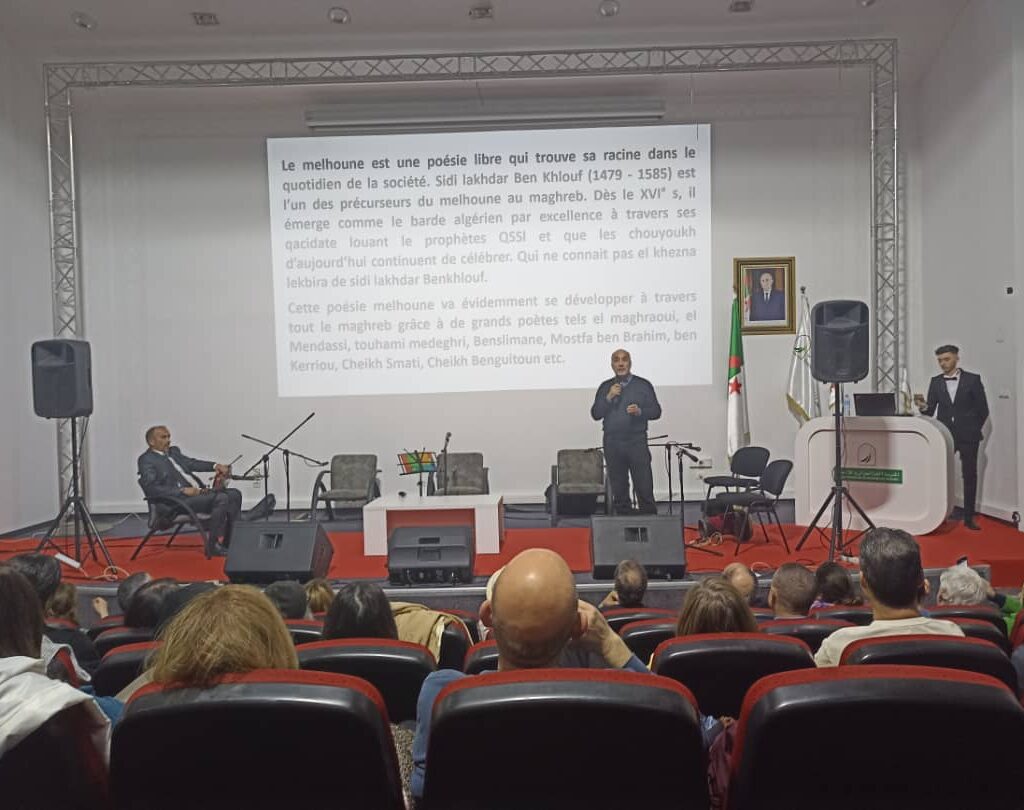
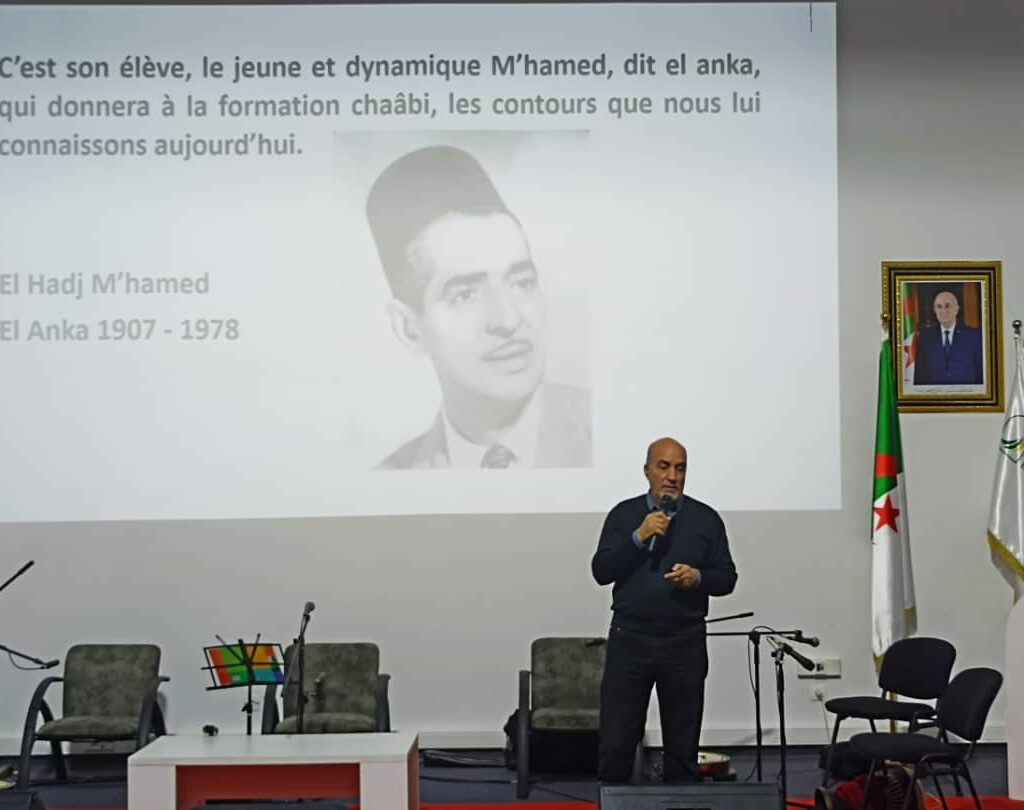
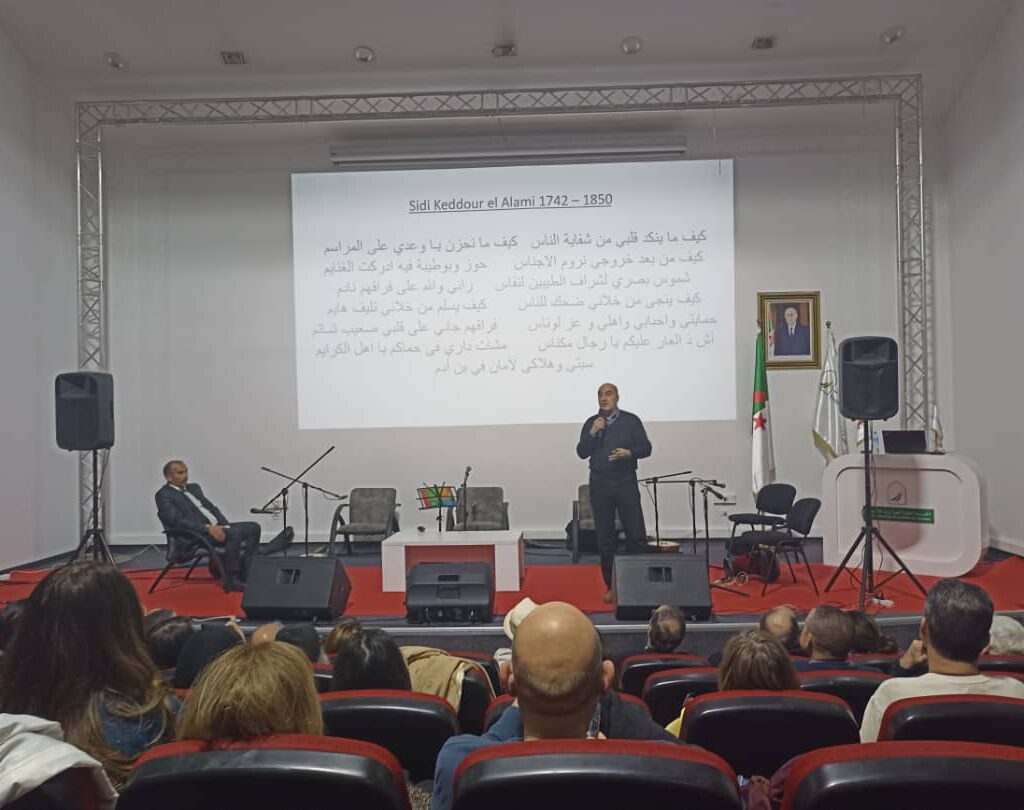
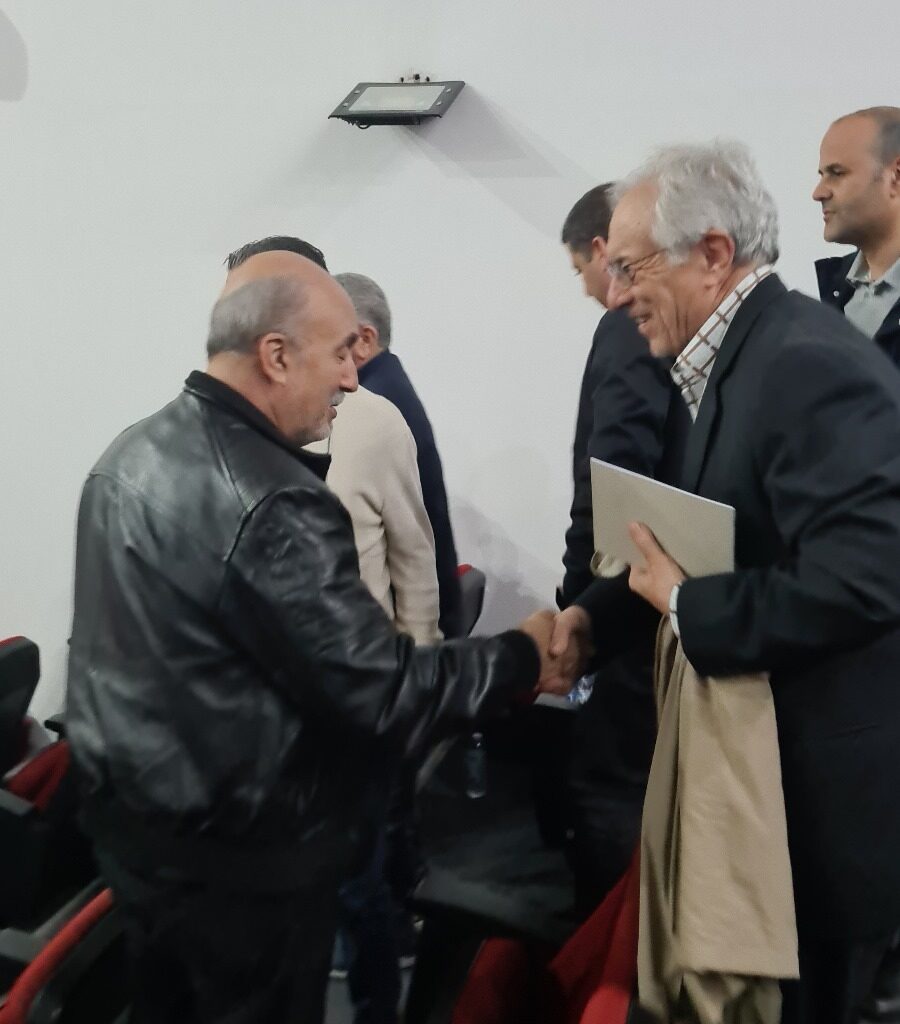
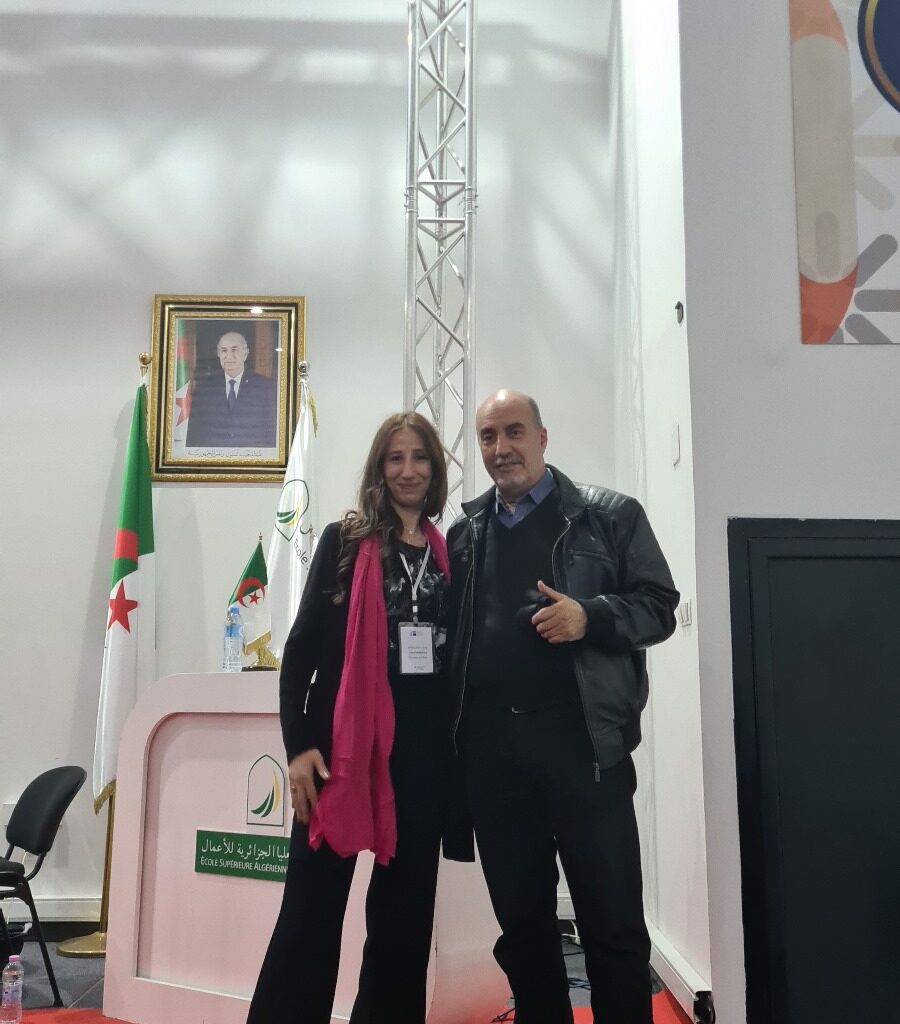
Une soirée de Ramadan à Alger, restera à jamais gravée dans nos mémoires grâce à lui et son ami Nacer GREFFOU (qui lui sert la main ci-dessous) qui nous a invité un soir de Ftour à la Chambre Algero-Allemande d’Alger à terminer la soirée à l’ESAA (Ecole Supèrieure d’Administration d’Alger. Nourredine SAOUDI, avec sa passion pour la musique arabo-andalouse, a partagé ses connaissances de manière scientifique et accessible. Il a su, avec l’appui d’un orchestre, illustrer ses propos par une musique envoûtante, rendant cette soirée unique et inoubliable.
Un Chercheur Humble et Brillant
Dr. Nourredine SAOUDI était non seulement un géologue de renom mais aussi une personne modeste, sympathique et très intelligente. Ses contributions en sciences de l’information et de la communication sont inestimables, et son humanité, exemplaire.
Nous rendons hommage à cet homme extraordinaire sur notre site Ameddias, où son souvenir continuera d’inspirer et d’enrichir nos vies.
This article delves into the complexities of modern media engagement and its impact on generational communication and social relations. Highlighting both the empowering and potentially detrimental effects of digital screens and multiplex media channels, it explores the role of creative industries and algorithms in shaping interactions. Through case studies, such as the controversial actions of the Icelandic band Hatari at Eurovision and the repercussions faced by young artists for their online expressions, the article underscores the nuanced relationship between media, societal norms, and individual behavior. The discussion emphasizes the importance of ethical media usage, awareness of surveillance, and the balance between effective communication and the risks of addiction and social isolation.
Risked engagements or risked communication?
Engagement via ICC can strongly help the youth to denounce something but it can also be biased and instrumentalized. In particular, with the punitive technologies that the French Michel Foucault in Surveiller and Punir (1975) does compare to the panoptic of Bentham: to suggest that one monitors continuously, gives a sense of permanent surveillance. Jeremy Bentham wanted to impose this thought in prisons, he wanted the prisoners to feel constantly being observed. The Jeremy Bentham’s prison model is very present in the idea of seeing everything without being seen. Commitment can be biased and orchestrated. Especially with the punitive technologies and Bentham’s repressive panoptic: to suggest that we are constantly surrounded today in our society via a lot of monitoring including social media. It institutes a sense of constant supervision.
Commitment can bring knowledge and values. It can also push the regulation of behavior including Bentham’s panoptic described by Foucault. Indeed, installing surveillance cameras can push individuals to behave properly, as you never know if someone is behind you. Already in 2014, the Chinese government installed a system of “social credit”. This system contains a notation of artificial intelligence fueled by algorithms is innovative to dissociate good and bad citizens. After several experiments, China’s social rating system is becoming clearer. In Beijing, it should be operational by 2020-2021. In Australia or India, this system is also seducing governments that can adopt it as soon as possible[20]. In the same time, an episode of the futurist TV series Black Mirror[21] –Nosedive – illustrates the negative implications of an Orwellian overreach system like the Chinese Social Credit. The title refers to ubiquitous screens that send us our reflection back. The Nosedive story shows how a digital system can affect freedom, and even freedom to think, pressured by a society that forces individuals to judge each other. Furthermore, in technology societies, the image can say much more and above all much faster than simple words. This, to “mark” where to point out something that is important to us. All of these, in addition to social media, can be very effective in demonstrating citizen involvement.
During the Eurovision contest that took place in Tel Aviv in 2019, the group Hatari, consisting of five young men (average age 25 years) represents Island with the title Hatriðmunsigra (Hate will prevail). If Hatari was noticed enough by their electronic genre, the originality of their atypical costumes and their performance on stage, it is during the announcement of the classification with the videos projected on the group, that a gesture will delight or upset the audience with irreversible way. Actually, the double surprise for the public was to know not only the rank placement of the group but also and especially to see them in this moment of the announcement, livestream, exhibiting Palestinian flags. This gesture, to show their long-standing support to Palestinian citizens. Indeed, before participating in the Eurovision contest, the members of the group had already shown their support and belief in a free Palestine, whose right to self-determination of people is still not planned. The information was relayed instantaneously on social media and subsequently, very diligently on the online media. What was less shared : the video of a security man trying to take back the Palestinian flag because of the Eurovision organization wanted to censor this legal gesture! For Sarah N. E., luxemburguish citizen who grew up in the israelian Palestine in the 80’s, the Eurovision sequences are incredibles : » I’ve seen that live last year, but as you know im living in Europe and most of life in the Israeli teritorry ,not sure many Palestinian are watching the Eurovision. More over we are quite used to such PR from many groups worldwide , its not new. Though in my opinion taking the flag from the participants or anyone, is outrages ! It just pissed me off . »
What has been relayed on the channel Twitter by Julien Bahloul, Head of communications at the Rothschild Foundation of Israel, is “the punishment” that the members of the group would have deserved. Indeed, the airline allegedly punished the protagonists by separating them from each other in the plane and placing them in the rows next to the toilet13. During this Eurovision 2019, Madonna also showed her commitment to Palestine, during her performance: two dancers met, one carrying a Palestine flag on the back of his costume, the other an Israeli flag. Consequences were not the same for Madonna, already known for her numerous humanitarian action[22], and for the young group, unknown from international screens. Still during the 2019 Eurovision contest, groups of militant of the French extreme right initiated an aggressive campaign on social networks to target the representative of France, Bilal Hassani, 19, after one former Twitter post. The young French affected by the massacres of the civil Palestinian population had written: “Are you stupid? The crime against humanity comes from Israel”. On risk and pain of not integrating the scene, Bilal Hassani apologized, arguing he was only 14 years old the moment he wrote this. After these apologies, the radio became silent.
Finally, to adress another example of screen capture and artist repercussions: the “Mennel case”. Mennel Ibtissem, 22 years old in 2018, candidate of the French version of the music show “The Voice” interpreted in English and Arabic the song “Hallelujah” from Leonard Cohen. Many spectators, on social media commented and greeted her performance the same evening. However, the next day, mainly French Internet users – some criticizing a scarf on her hair – explored the young woman’s digital past digging up Facebook messages she wrote in 2016 following the attack in Nice. There she shared her doubts about terrorist attacks conclusions. About another attack the same year in Normandy, she posted on FB: “the real terrorists are [the French government]”. As a consequence right-wing extremist groups from all sides, and the association of the victims of Nice, asked the channel TF1 to “give exemplary” to this polemics. This request, while the young singer has already tried to explain on FB social media that what she wrote, in a sadly schocking atmosphere was the expression of fear that she only shared at that time, with her friends on the FB network. Mennel Ibtissem finally announced her forced departure from the show. The production company, ITV Studios France, embarrassedly deplored that, despite sincere apologies from the candidate, the environment remained too heavy. In 2018, Mennel announced on another social media, Instagram that she quitted France to live with her husband in the United States. In this sense, sharing an opinion online – which is about freedom of opinion and criticism in a private sphere – can have irreversible repercussions years later in the public sphere. The newspaper L Express stated: “Anything you write can now be held against you (…) A phenomenon that has become commonplace”[23]. This is precisely the image of the candidate of The Voice, which the article illustrates. The following title of an article summarizes the situation of young mediatic actors aged between 17 and 27 years to be faced by future outcasts of media companies: “A la recherche des vieux tweets, l’archeologie numerique est devenue la norme”. With these “digital traces” and motivated investigators, it is important to raise awareness about the consequences of one’s actions.
Commitment can be dangerous and prejudicial for young artists not aware of its impact on their image. The case of the Islandic group Hatari and other international cases show that even if you risk to get punished, many causes have already been highlighted within music entertainment. In addition to collective lobbies calling for acts, demonstrations or even uprisings and acts of defamation. “Freedom of expression”, “freedom of opinion”, “freedom of criticism” … one can express oneself, a post can always be reported, therefore deleted-, but to think or to have an own opinion can lead to rise and fall, to the loss a support when the majority does not think the same thing. However, the majority is to relativize too, according to the power of accessibility of the Internet.
Screen generation’s pathos and prevention
Engaged citizens for cause seduced by the multiplicity of medial channels to share thoughts and values, can also derived to other media practices… that could become literally speaking… addictive! In 2019, the Algerian newspaper El Watan is questioning: ”Facebook, une drogue des temps modernes”? 20. The article investigates looking at 20 million Algerian profiles on the average time spent on FB. The people to whom the journalist Amel B. asked the question “How much time do you spend on FB?” seem to have had trouble answering it. Despite the positive uses that everyone can make of FB, we will find that the time devoted to it, may prove unhealthy and even detrimental. Furthermore, in less advanced countries in term of acquisition of creativity, it is hard to face the difficulties, because of the emergence of technologies “without transitions”. Citizen can pass from a Nokia 3310 to the latest Algerian smartphone Condor. If those advantages are “moderatly” used, a social media as FB can be didactic. But no limit of time leads to no consciousness of the space around. Algerian private channels replaced by Youtube emissions, “beep” that prevent sleep, rushes on the phone to check the origin of the notification, TV as a background, each and every one, smartphone in the hand… No consciousness either to measure risks as theft of identity, defamation, harassment… FB seems to be present, all day, all night long for those who go to their account while waking up, then in the bus on the way to class, in the auditorium when the course is boring. During the night, the risk is also to be wake from a notification on messenger or a comment, etc. Stress, in sum, to manage and confessions such as will resume Hakim a student interviewed: “It was a drug. I couldn’t stop alone”. So how to come off from social networks in a country where leisure is small?” asked finally the journalist.
An internet weaning seems difficult, specifically for social networks, which can quickly turn into a monster, swallowing its users. Several studies significantly correlate the increase in the number of divorces with the number of pathological hours spent on social media have an impact for the youth living through the divorce of their parents or young couples destroying their home projects.
Obviously, there is not, at present, epidemiological studies of this addiction, an addiction not considered yet as a disease by the World Health Organization. In Japan, for example, the Hikikomori[24], a youth addicted to Internet, is of great concern to the public authorities. This pathology concerns young people who do not go out of their homes, do not receive anyone and only exist through their many profiles on social media. Japan fears an epidemic. In Constantine, Algeria, a detoxification center of the Internet, the CISA (Centre intermediaire de soins en addictologie) , the first of its kind in Africa and the third in the world after South Korea and China (in the public sector)opened in 2012 to treat addictions to drugs, alcohol and tobacco.
The CISA Constantine hosts since 2013 patients aged 13 to 63 addicted to the internet, including Facebook, Instagram or Twitter. People who are aware of their addiction are entitled to a moral support therapy, with relaxation exercises to be performed when the lack is felt. For the CISA specialists, more than 38 hours of connection per week (outside of work) are synonymous with addiction. In this rehabilitation center, it is assumed that it would take six to eight months, or even a year, to fully regain control of life.
Numerous addiction pathos are discussed and many words borned to describe this. To quote two of the most famous expressions from a lexicology adapted to the time: the Canadian word “infobesite” and the acronym “FOMO” linked to the Internet addiction pathos. For Caroline Sauvajol-Rialland, lecturer at the Catholic University of Louvain, the information overload brings to isolation, cocooning, forgetting, and outbidding communicational info: when we receive more information than we can bear. On the other hand when one no longer receives anynews, no information, isolation becomes immanent leading to the withdrawal into oneself like a paradoxical form of social death. FOMO – the Fear of |Missing Out – is relative to the fear of missing the latest news, the latest technologies, the latest parties, the fear of not being updated by what is going on… This fear increasing with augmented reality is the result of the constant interpenetration of the connector and the disconnect. Without forgetting migraines because of the screen, reduced visual acuity, lack of appetite… Using tools to be engaged, to inform, to be informed and to communicate quickly and efficiently is helpful for a cause. Using time to do this should be handled carefully, with a lot of precautions. And because of the various fears to be missing something or being left out when one is off-line, youngest generations should particulary be awared and prepared for these problems.
Conclusion
Thanks to the Internet, social media and specialized websites abound on video platforms relayed indefinitely by sharing links to multiple social media. We find many channels inviting us to reflect on our world and our society. Citizen commitment is not anymore reserved for elites, everyone can manifest itself on its scale of course with CreICT and any contribution is important. In general, the use of multiplex channels by the generations of the screen has positive effects on the commitment; however, we must be careful while cultivating this positivism. Engagement can lead to success or, on the contrary, to failure.
Indeed, geopolitical or socio-legal contexts differ internationally. Models differ according to economy, connection, legal framework and social interactions. The idea of connection and permanent closeness is not the same internationally. To zap on line, so fast from one interlocutor to another can lead to the detriment of human social relations, inherently fragile without face to face exchanges and conversations or perception of feelings. To be preserved they require effort, attention, time. Indeed, the digital screen channels changed the experience of space and time, therefore usual landmarks. It s seems that time became a luxury nowadays, as reminds us the word of the Information and Communication Sciences Pr. Alexandre Marius Dées De Sterio (1944-2006): ”Would free and freely available time have become the only, the true, the real luxury of our time?”.
Linda Saadaoui – PhD Information and Communications Sciences
Nasreddine Bouziane – PhD Information and Communication Sciences
Bibliography
Alexander M., 2010, The New Jim Crow: Mass Incarceration in the Age of Colorblindness, The new press.
Barthes R., 1980, La chambre claire. Note sur la photographie, Paris, Gallimard.
Bourdieu P., 1996. Sur la télévision, 1996, Liber-raisons d’agir.
Bump P. « Here Is When Each Generation Begins and Ends, According to Facts », The Atlantic, 25/03/2014.
Debord G., 1967, Société du spectacle, ed. Buchet/Chastel.
Florida R. (2008). Who’s your city? How the Creative Economy Is Making Where to Live the Most Important Decision of Your Life, New York, Basic Books.
Foucault M., 1975, Surveiller et punir, Gallimard, 1975.
Hesmondhalgh D., Howkins J., 2002, The Creative Economy: How People Make Money from Ideas, Penguin Global.
Hephzibah A., « Never heard of Fomo? You’re so missing out », 17 avril 2011 Przybylski M.,DeHaan, G., « Motivational, emotional, and behavioral correlates of fear of missing out », 2013, p. 1814–1848.
Howkins J., (2002).The Creative Economy: How People Make Money from Ideas, London, Penguin Press.
Kellner S., « Is FOMO depriving us of our ability to exist in the present and take pleasure in the here and now? », The independent, 13 january 2013.
« Migration ». An ubiquitous term in political, legal, economic and environmental news. What does the media sphere mean? What migration flows are we dealing with? Nowadays, many researchers prefer to speak of « mobility » or « circulation », the terms being more explicit to understand fluxes with variable geography in time. « Migrants ». A term that encompasses all types of citizens in a context of traffic, caused by wars, the environment, the economy – refugee citizens, applicants for international protection, climate displaced, cross-border workers, brain drain pensioned exiled or even taxpayers… Among all these types of profiles, one thing in common: the search for a better life. In this quest, we can observe some positive constants over the course of history such as host country stability or the wealth of socio-cultural exchanges. However, the recurrence of discourse of rejection remains dominant. Over time, we can see the stakes of deontological information regarding the representations of displaced populations (invaders, criminals, rapists, etc.). These are media representations of « migration » which we will deal with in the prism of the most stigmatizing news items, the most denunciatory cartoons, from the Old Regime to the present day, in the Mediterranean basin.
Keywords: e / im / migration, history, press, stigmas, caricatures / Article FR
Media projections around « migrants » – Searching well-being or to face a rejection?
Among all the regions of the world, the Mediterranean basin is a remarkable observatory: from Egypt to ancient Greece, through the period of the Crusades, the Ottoman Empire, or the 19th-century working class up to the present day, mass migrations have been renewed. These flows thus contribute to the construction of new spaces. Despite the variety of historical contexts and disruptions, it is possible to detect a number of continuities, recurring images, in the narrative of migration phenomena. If we look at the media representations of these continuities, we must at least go back to the 19th century with the emergence of courtroom press under the Ancien Régime. In those times of intra-mural and then cross-border migrations, news reports relied on accounts that tended to violently stigmatize all migrants. Nowadays, this kind of stigmatization is renewed and intensified with the digitalization of information. To illustrate these media coverages, we will draw on works from intersecting disciplines between History (Vigarello, Noiriel, Gastaut, Kalifa), Information and Communication Sciences (Bonnafous), and the interdisciplinary network MIMED (Migrations in the Mediterranean). We will thus focus on the media perceptions of the 19th and 20th centuries before concentrating on the reception of information on current circulation flows in the Mediterranean, through the cartoons of press cartoonist Ali Dilem. Finally, we will advocate for more ethical information concerning the quest for well-being and the risk of rejection that the so-called « contemporary migrant » will face.
The rural migrant in the press of the Ancien Régime
From the Latin « migratio, » derived from the verb « migrare, » the term « migration » refers to the act of migrating, leaving a place, changing residence, departing, emigrating, etc. Understanding contemporary migration flows also involves considering their complexity throughout history. Populations leave, some only pass through, others shuttle back and forth with their country of origin. However, throughout history, with population movements, newcomers are often blamed.
In France, under the Ancien Régime, the urban world detested rural migrants and the societal changes related to new forms of labor. The image of these immigrants was built on prejudices: they were seen as foreigners invading the space and taking others’ jobs for lower wages. At that time, the work involved service jobs in hotels, restaurants, management, and sales in shops. Rural migrants were thus considered job thieves, taking easier jobs initially reserved for women, as they required less physical effort in those industrial times. Focusing on the media perception of this working class, one will also notice through news reports that, in addition, the rural person, the « pauper, » the « louse-ridden, » was often depicted as guilty of the most abject crimes like rape. These are the same taboo crimes, the dark figures, « grey numbers »1, committed in all other social classes but overrepresented in the media when it comes to rural migrants, making the « lower » social class appear the most criminal and uneducated among the French. Thus, in the early 19th century, public opinion equated aggressors with frustrated monsters from the rural world. As summarized by historian Georges Vigarello, poorly known populations were instantly stigmatized as « barbarians » and guilty (1998: 187):
“Industries, their congestion, the more numerous migrants fascinate and worry. The fear of violence targets less the countryside than the streets, this previously unknown promiscuity in cities […]. The « savages of Paris, » those of George Sand or Eugène Sue, are as many « barbarians living among us, » « tribes » reinforcing the certainty of an increase in crime, workers of a new kind, migrants from the countryside bringing anxiety to the heart of cities.”
With these new unknown populations around the city, the portrayals painted by the press did not necessarily help their integration. The image of this intra-muros migration in the metropolis is noticeable in the French press La Gazette des Tribunaux2. Born in 1825, the newspaper specialized in court reporting, did not escape the trend of sensational news, a lucrative business. At that time, its revamped formula was part of a new press that generated curiosity by addressing all social classes. As Georges Vigarello noted (1998), the daily newspaper thus reflected a new criminal topography when it serially reported, around 1840, the sexual crimes committed by workers, intermixing adult rapes and child rapes: “indecent assaults are frighteningly renewed” (12/10/1838), especially those of “quarry workers” (20/05/1833), “bricklayers” (06/05/1841), “chimney sweeps” (20/06/1833), “charcoal burners” (02/04/1842), “two half-drunk men on a female worker” or on “a young girl returning from a ball” (20/04/1842). Perceived as false individuals, people to be banned, they were associated with places forgotten by progress and depraved. They came from the suburbs – boroughs of the city – and were seen as false and filled with false, uneducated bourgeois, just as the suburbs referred to people « banished from the place, » at least one league away from the city at that time. Press headlines related to these working-class neighborhoods followed: “young men from the Faubourg Saint-Antoine on an underage girl,” or “12 printer workers from the faubourg,” prompting La Gazette to “call for all the severities of justice” (12/10/1838) for acts “repeated several times, always under the same conditions in the Faubourg Saint-Antoine” (01/05/1841)3. One can see that the sensational news revealing social representations operated with a particularly formidable mechanism in the case of immigration: it revealed social unease, but also rejection, a certain xenophobia. The place nourished the stigmas. For the press of that time, violent offenses like thefts and assaults belonged primarily to the world of villages and hamlets. The argument was even systematized since the 18th century, fixed on a conviction: “the incompatibility between the existence of certain crimes and the existence of civilization” and “the association of murder or rape with a rural world made of archaism opposed to an urban world made of modernity” (Vigarello, 1998: 131-133). Progress was measured by urbanity: the city, its development, and its lights should drive away violence and sordidness. Finally, the utopia of an industrial and urban civilization, ready to remedy all the ills of society, slowly took shape: civilization should erase crimes and offenses. It is at the heart of these certainties, however, that questions arise about the reality of violence and the way to evaluate it, the city and crime suggesting previously unknown concerns.
Indeed, speaking of a “world of villages and hamlets,” and comparing it to “places forgotten by progress,” one can see, through press analyses, a “civilization trial” designating French rural migrants as “uncivilized” here, and by simplistic association, opposing them to modernity as supposedly primitive and ignorant (Saadaoui, 2010). These reflections lead to questioning the effects of an urban pathology. The city would rather be a counter-example, a “sticky den of corruption, a chasm of temptations” whose congestion would exacerbate all dangers just as the increase in crimes and offenses would only signify a growth in “urban turpitudes and depravities” (Vigarello, 1998: 136).
Additionally, demographic studies such as those by Jean-Claude Chesnais (1981) align with the aforementioned historical observations. They examine the perception of these ever-present new migrants, who are now migrant couples, grouped families, and not single men arriving in the city. While the figure of the barbaric murderer is still part of the crime imagination, the press then informs about a threat that becomes more precise, more localized: it is the fear of the neighboring migrant that replaces the fear of the rural dweller, the border migrant – even if urban – being even more « foreign » than the rural French: the Italian and the Belgian first.
« Civilization trial » of the cross-border economic migrant
Up to today, one can see a slow « civilization trial » (Saadaoui, 2010: 17) repeating in these historical reproaches, stemming from Norbert Elias’s work on the processes of civilization (1969), which posits that the « civilized » society, the « court society, » assumes the duty of civilizing other social classes in its own image. With this civilization trial, a new urban sensitivity emerges: « a city feared, revered, and hated where the moral and sanitary norms of the 19th century are born » (Vigarello, 1998: 186), such as the behavioral norms confirming the « emergence of another France » mentioned by historian Yves Lequin (1983: 193). Received ideas are entrenched, notably the one that foreigners are a burden on society and a threat to national cohesion. It is difficult to counter these preconceived notions about migrants without considering a political context that is either favorable or resistant to immigration.
From a rather media-political perspective, prejudices against immigrants from Africa, Latin America, or Eastern Europe increase with the rise of extremism. If we return to the Ancien Régime in France, as explained by Georges Vigarello, we see that the reports in La Gazette des tribunaux (27/02/1887) portray the perpetrators of rapes or gang rapes committed by « foreign » accused individuals: « the Italian subject, an ignoble character, » « Belgian subjects » depicted as « ignorant » or « brutish, » driven by « perverse passions, » frequently make headlines with reductive labels. La Gazette thus creates a « culture of crime, » which increases its national audience, which had long remained modest in its beginnings. Historian Dominique Kalifa (1995: 121) reinforces these observations by discussing the press of the time, which tends to reveal more violent confrontations when they are committed by foreigners, especially if they are brawls after drinking, among workers, between French and Italians, and also among Italians. Such stereotypes often targeted foreigners who joined the lower social classes, equated by the press with « barbarians, » uncivilized people, and new « dangerous classes. » As historian Gérard Noiriel (1988: 249) explains, at the end of the 19th century, while it is true that Italians and Belgians were victims of intense xenophobia, especially in the working world, it must also be noted that the three modern French economic crises (at the end of the 19th century, and in the 20th century during the 1930s and from the mid-1970s) sparked waves of xenophobia against new migrants coming to work. It is clear that the young French working class frightens people, and it is no longer the rural or « migrant » foreigners from the French borders, but the popular and working classes who play the « role of the threat. » The weight of words must be considered in a discourse that can lead to sensitive controversies, as illustrated by the sensational news discussed in the 19th century. Analyzing the discursive forms representing a particular socio-demographic population is useful for understanding the image of first-generation and then second-generation immigrants in the late 20th-century press. The handling of a controversial subject and the ensuing media discourse must be approached with caution. This is precisely the point highlighted by researcher Simone Bonnafous in her book « L’immigration prise aux mots. Les immigrés dans la presse au tournant des années 80″ (1991). This study examined the virulent attacks against populations from North Africa in a section titled « Far-right: from theory to attack » (1991: 48-62). She notably shows through examples from the press how reports and investigations on sensational news can be organized around narratives describing the horror of crimes and offenses committed by immigrants. These immigrants are also accused by the far-right press of the 1950s, such as Minute, of being the rapists of « our » women. For example, the title of the report from October 5 to 11, 1977: « Victim of fifteen thugs, Brigitte is mutilated forever and yet… the ARAB RAPISTS are FREE. »
Stigmas of the so-called immigrant generations
At the end of the 20th century and the beginning of the 21st century, history repeats itself once again, this time for the generation of children born in France, socio-politically referred to as the « second generation of immigration. » The stigmas persist and renew with the most abject crimes — such as gang rape, which the media-political sphere now calls « tournantes » (gang rapes): a woman is « turned, » like a pornographic recreational activity, akin to a « gang bang. » Once again, this is a process of exploiting the « news item that diverts attention » from the country’s economic woes, as examined during times of mass industrial relocation in the 2010 doctoral thesis in Information and Communication Sciences, « Media Treatments and Interventions Around ‘Tournantes’: From the News Item to the Immigration Question? » (Saadaoui, 2010). This occurs in a context where other discourses intersect, where themes of rising insecurity and xenophobia are prevalent in the debates accompanying the 2002 presidential election campaigns. The targeted news item aimed at a specific population appears as an additional trigger for national « moral panics » — as already discussed for French migrations in the 19th century by Gustave Lebon in his aptly titled work, The Crowd: A Study of the Popular Mind (1895). The lack of education and reference points among the so-called first generation of immigrants has often been a spearhead to explain crimes or offenses committed on the outskirts of the city, generating fears and psychoses. Many media treatments focus on the « children of immigration in disarray » (Le Figaro, 11/05/2002).
In 2002, during the year when the press discussed gang rapes as « tournantes » the most, France 2 allocated 100 minutes of prime-time TV to political personalities invited to reflect on the French social climate, not in relation to the primary socio-economic concerns of the French people, but in relation to the theme of insecurity4. Additionally, the then-Minister of the Interior, Nicolas Sarkozy, announced a firm policy towards the « barbarians »: « When they gang-rape in groups of ten, I call them barbarians committing a crime. It is time to use the right vocabulary, » he said on the television set. With this perspective, it is not surprising to see the extreme right-wing party National Republican Movement’s website unabashedly define « tournantes » as follows:
« Tournante: an ‘initiatory’ gang rape, characteristic of the suburbs and cities under the rule of ethnic gangs […] Although difficult to evaluate due to the victims’ silence fearing reprisals, the number of these heinous crimes, mostly affecting minors, is reportedly on the rise according to all specialists. »
Many extremist and xenophobic parties will appropriate the discourse on « tournantes » to point out civilizational problems among the perpetrators of gang rapes. Other openly Islamophobic websites will soon link gang rapes, immigration, and religion, with the same causes producing the same effects. To reach such statements on the web, it is interesting to observe the semantic shift from the news item to the societal issue through the informative discourse.
Once again, information affecting the « image of the elite France » is less mediated. The trial of Parisian CRS officers jailed for gang rape on foreign prostitutes (Le Figaro and Le Monde, 13/12/2003) or the Lille police officers jailed for gang rape (Le Figaro, 28/05/2002) are more obscured. A trial of abuse of power is somewhat covered, following a hearing report of four police officers in Albi, avoiding Assizes for four peace officers presumed guilty of rapes. Journalist Françoise-Marie Santucci for Libération (03/07/2002) recounted the victim’s drama, Laetitia, a young 19-year-old mother, and the sentence imposed on the perpetrators: a simple suspended sentence for several rapes committed between December 1999 and January 2001. Another journalist, Stéphane Thepot (Le Monde, 04/07/2002), reports a statement from Maître Gaubert, the public prosecutor, not without a striking comparison: « It wasn’t a ‘tournante’ like in the suburbs, but a ‘farandole’, » said Mr. Gaubert, who requested the confirmation of the sentences pronounced. » Through these hearing reports, the protagonists differ from those targeted in the treatment of « tournantes. » In this « farandole affair, » there is a defense pattern for the presumed perpetrators, similar to most presumed perpetrators defending themselves by arguing the victim’s consent and the lack of perception of the severity of their acts.
Beyond borders, still in full economic crisis of industrial relocation, the representations of immigration are similar, with once again, a tarnished image of their descendants. If we look at the francophone border presses, Belgian or Swiss, the immigrant’s son appears just as dangerous. In Belgium, for the daily Le Soir, the fault is attributable to the other, the foreigner, often the « African. » This is evidenced, for example, by the article titled: « Justice – Judicial Backlog. Courts Paralyzed Due to Lack of Police Officers (Le Soir, 18/05/05) »:
« On the side of the 54th correctional chamber, to give the priority that is due to a major gang rape case attributed to a gang of young Africans, the MAF (for African Mafia), few cases were scheduled. »
Sabine Pirolt for the Swiss press L’hebdo (23/11/2007, pp. 76-82) dedicated a dossier to the « Swiss gang rapes » titled: « Gang Rapes: Tomorrow, Your Daughter? » In this writing, the media treatment of rapes committed by foreigners in Switzerland is similar to articles in French or Belgian dailies, with the difference that the targeted immigrant populations or their children are often foreigners from the Balkans. The media treatment in Switzerland and Belgium, for part of the francophone press alone, reveals that there are no ideological borders for the fact that the culture of the country of origin can be stigmatized in the host country. The media relay of rape is once again imposed through the lens of immigration, not only for immigrants but also for their descendants, even if they have evolved in values of equality and fraternity.
In this sense, the media treatment of gang rapes, termed « tournantes » at the beginning of the 21st century, reveals a difficult integration process of migrants in the history of French society rather than a phenomenon of exclusion specific to the present time.
Premises of the Caricature of the « Mediterranean Migrant »
Whether through images (cinema, television, press illustrations) or text (articles, reports, dossiers), it is evident that the major headlines of national and regional daily newspapers and weeklies generously fuel the phenomenon of « moral panic » to its peak. This shows that the dark representations of immigration attributed to a particular population remain a significant subject of study today. For instance, the highly publicized crossings of migrants from Africa to Europe via the Mediterranean have seen journalistic treatments contribute to a climate of panic even during the flow of migration: with pathos, narratives lamenting the plight of « migrants, » and also socio-economic projections that pose threats to the host country.
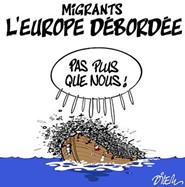
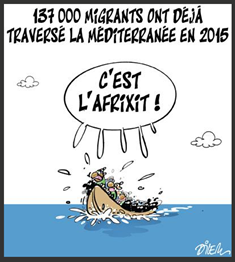
In terms of caricatures on the crises of migrant crossings in the Mediterranean basin, numerous publications by Dilem, an Algerian press cartoonist5, illustrate the issue with humor that blends cynicism, mockery, irony, sarcasm, and burlesque. Under the title « Migrants – Europe Overwhelmed » (Figure 1), the passengers in an overloaded makeshift boat respond in unison, « Not more than we are » (Liberté, 01/09/2015). Another cartoon shows an overloaded boat at sea with the title « 137,000 migrants have already crossed the Mediterranean in 2015 » (Figure 2), and the passengers remark, « It’s the Afrixit! » (TV5 Monde, 03/07/2015). This refers to the financial concerns of Brexit compared to those of African citizens—from North to South. Many caricatures denounce, in the era of the digital industrial revolution, the living conditions of Africans leaving the continent for better economic opportunities, similar to the political motivations seen in the United Kingdom.
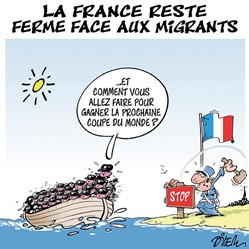
Beyond the migrant crossings, their arrivals are also caricatured. For example, one illustration shows a full boat arriving on a beach where a French policeman is placing a « STOP » sign. A passenger responds, « …And how are you going to win the next World Cup? » (Figure 3 – Liberté, 19/07/2018). This image criticizes the inhumanity faced by an economically selective immigration policy, rather than addressing the ignored humanitarian aid.
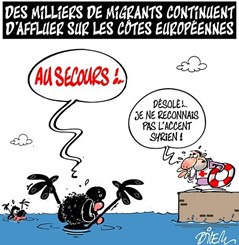
Regarding arrivals from Africa, we see two men in the sea raising their arms, with one shouting « Help! » Facing them is a Red Cross worker with a buoy on his arm, responding, « Sorry!… I don’t recognize the Syrian accent! » (Figure 4, Liberté, 12/09/2015). This implies that France seems to be concerned only with Syrian expatriates seeking international protection. In this sense, the hypocrisy of Europe and, subsequently, the NGOs that finance more political than humanitarian measures is depicted. These measures are still self-interested, as illustrated by the European disputes over the significance of operations amidst the increasing number of deaths and disappearances at sea between 2011 and 2015.
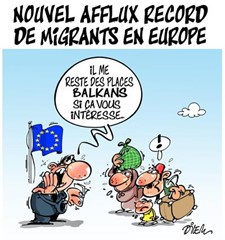
In 2013, the Italian government and its navy initiated Mare Nostrum, sea rescue operations, but this measure was replaced at the end of 2014 by Triton, a European security operation – not a humanitarian one – aimed at deterring citizens departing from Africa. This desire to repel was particularly evident through financial aid and training provided outside the Schengen Area to destabilized countries such as Libya6. Even when immigration appears to be legal with migration flows, it still seems unwelcome, with arguments suggesting that a family of migrants from North Africa would be directed to the Balkans rather than to another part of Europe, implicitly an « Europe of the Six »7. Thus, countries like Bulgaria, Croatia, Greece, Romania, and Slovenia, now members of the European Union, seem equally depreciated and rejected, as illustrated (figure 5). In short, a second-rate Europe, cheaper and more accessible, like football tickets for national teams sold on the black market outside stadium entrances (TV5, 26/10/2015).
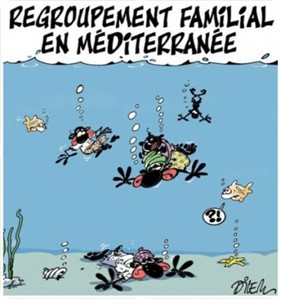
A notable caricature by Dilem is entitled “Family reunification in the Mediterranean” (figure 6, Liberté, 04/19/2015). We can see a mother and three children, joining the drowned father in the depths of the sea, lying on his stomach in the middle of living fauna and flora, fish, shells, starfish, algae… The bubble of fish » ?! » can translate a form of candid questioning, about these improbable arrivals in their environment. The drawing was published on the LICRA8 Facebook page, leading to numerous derogatory messages, which forced it to remove the drawing. For the French weekly Courrier de l’Atlas, journalist Nadir Dendoune was particularly interested in this caricature and its feedback in 2015. For the journalist, via social media, many Internet users were outraged at “a variable geometry of freedom of expression that is regularly singled out.” He cites in particular Sadia, a Senegalese living in Paris who testifies to this burden of “double standards” that he feels: “We can laugh at everything but not with everyone but the problem is that everyone laughs at us « . The journalist also cites, among other testimonies on the injustices of the world seen through the press cartoon, Fatou, a Marseillaise:
“In 2015 we still draw black people with big red mouths like Tintin in the Congo, it’s pathetic. But I don’t think it’s to make fun of migrants but rather to denounce what is happening. I don’t think the humor is directed at black people. But, they rather denounce the smugglers: these sellers of the dead. They denounce the inertia of the European and international community. Of course, it might be shocking, but that’s what I see when I look at this drawing. »
This representation by Dilem undoubtedly stands out today as one of the most illustrious denunciations of what is happening in the Mediterranean; as a wake-up call to « put into words » a reality more than a fiction about the daily lives of what are called in the Arab world the « harragas, » the « burners » – in the sense of border burners. Ahmed Ould Djemri Saadaoui, president of the Amicale des Algériens en Europe in Nancy9, who was part of the so-called first generation of French economic immigrants in the 1950s, testifies to the perception of migrants in the news during these crises in the Mediterranean Basin. For his peers, immigration was chosen and desired by countries in need of labor migration. This « sacrificed generation » addressed by the sociologist Abdelmalek Sayad (1999) also contributed to the economy of their country from abroad. In short, with the same determination as contemporary migrants, who are considered outcasts, undesirable but still participating in a cross-Mediterranean economy on both shores. For him, this image of harragas crossing the sea speaks volumes about the societies they come from.
« It is important to notice the contribution of harragas to the awareness of malaise in countries that are rich in resources and rich in motivated youth. These departures are a painful break for the family, but also for the homeland, with a sense of escape, a despair of a youth dreaming of a society optimized by their skills. They no longer dream of it in the face of corruption made ‘legal’ by governments, an all-powerful oligarchy that despises its people by giving them crumbs… Governments even more stuffed by policies and multinationals benefiting from African people and wealth. The departures of harragas show the urgency to rethink so-called democratic systems. »
Political scientist Cherif Dris, in an article on « New Figures of Immigration. In France and in the Mediterranean » (2008), questioned the place of migration issues in Euro-Mediterranean relations by emphasizing the paradoxes of EU immigration policy. Now, the intensification of the fight against illegal immigration turns into a security obsession on one side; the diversion of gray matter from Southern countries on the other. Whether it is called « chosen » or « non-forced » or « concerted » immigration, the risk is the same: keeping these countries in a situation of permanent dependence and underdevelopment. In the end, around the Mediterranean Basin, media interventions on immigration have made waves, and the theme has been taken up internationally. Other countries have used the news and have also experienced media drifts. Therefore, it seems wise to reread the historian Gérard Noiriel already in 1988:
« Of all the old immigration countries, France is the one where immigration flows have always been most closely dependent on the state of the labor market. That is why there is here a stronger link than elsewhere between economic crisis and xenophobia. Indeed, in democratic societies, the essential role of spokespersons is to name the crisis, to designate responsibilities, to propose solutions. Each national society, given its own political traditions, has a ‘stock’ of stereotyped formulas, ready-made explanations, easy scapegoats, which are mobilized to satisfy the electorate and which are found in the political press. »
For Vincent Geisser, a political scientist whose work focuses on the same period as that of Simone Bonnafous previously cited, these types of representations by the press in the 1990s are symptoms of the ethnicization of scapegoats chosen for nationalist political purposes. Thirty years later, following the 2019 European elections, seventy-three far-right MEPs, led by the National Rally and the Italian League, announced the creation of the parliamentary group « Identity and Democracy (ID). » The researchers of the MiMed (Migrations in the Mediterranean) network in Aix-en-Provence, Virginie Baby-Collin, Sophie Bouffier, and Stéphane Mourlane aim to cross disciplines such as history, archaeology, sociology, geography, political science, etc. Their work aligns with the conclusions of interdisciplinary researchers in the fields of Information and Communication Sciences, History, Sociology, and Demography: it makes no sense in terms of history to imagine that we can close borders and live among ourselves. The worldview of everyone at home is certainly not new. Rejection discourses repeat themselves throughout history. Only the populations change when each new generation of migrants is perennially accused of all vices. The repetition in history of these discourses is based on the idea that migrants represent a threat. They are perceived as political enemies, as a source of trouble for society, as unfair competition in the labor market, or even as factors of cultural degeneration. The researchers at MiMed also focus their work on migrations as initiators of synergies leading to the creation of other enriching cultures for both locals and migrants. This again corresponds to the socio-demographic reality that, in addition to integrating individuals into cultures different from their own, there is also the construction of new identities beneficial to everyone. And undoubtedly, the examples observed in the Mediterranean are just a concentrated version of what is happening elsewhere in the world.
Conclusion
If we look back in time, we see that migrations have always brought incomparable wealth with exchanges of cultures and diverse knowledge. The rejection of settled residents, regardless of their origin or geographical heritage, prevails over the acceptance of their quest for well-being. A reflection on the role of the media as a mirror of certain discourses needs to be deepened: despite a very different representation from the reality on the ground, there can be a true distortion of reality that reflects the functioning of the media landscape. Historian Yvan Gastaut and social mediator Bruno Quemada also question in their book « Migrations: when prejudices come into play » (2007), too many prejudices throughout history lead to rejection, exclusion through images conveyed by cinema, the press, extremist lobbies… In this context, undoubtedly, what is the purpose and strength of the law? How can we effectively fight against stigmas? Also, to better understand our present and the complexity of certain phenomena that are thought to be unique when they repeat overwhelmingly, it is necessary to look to the past to advocate for a return to freedom of movement.
Dr. Linda SAADAOUI – PhD. Information and Communication Sciences – Ameddias Luxembourg
Bonnafous S. (1991). L’immigration prise aux mots : les immigrés dans la presse au tournant des années 80. Paris, France. Éditions Kimé.
Chesnais J.-C. (1981). Histoire de la violence en Occident de 1800 à nos jours. Paris, France : R. Laffont.
Elias N. (1973). La civilisation des mœurs. Paris, France : Calmann-Lévy.
Kalifa D. (1995). L’encre et le sang. Récits de crimes et société à la Belle Époque. Paris, France : Fayard.
Lebon G. (1895). Psychologie des foules. Paris, France. Édition Félix Alcan, 9e édition, 1905.
Lequin Y. (1983). Les villes et l’industrie. L’émergence d’une autre France. Paris, France : Armand Colin
Sayad A. (1999). La Double Absence. Des illusions de l’émigré aux souffrances de l’immigré. Paris, France : Le Seuil, coll. « Liber ».
Noiriel G. (1988). Le creuset français. Histoire de l’immigration, XIXè-XXè siècle. Paris, France : Le Seuil.
Vigarello G. (1998). Histoire du viol XVIe- XXe siècle. Paris, Le seuil.
Contributions de livres
Saadaoui, L. (2009). « Perceptions psycho-sociologiques de l’immigration dans le traitement médiatique du fait divers « tournantes » ». Dans A. Cherqui & P. Hamman (dirs), Production et revendications d’identités, Éléments d’analyse sociologique (p. 117-131). Paris, France : L’Harmattan coll. Logiques sociales.
Sayad A., (1997). « L’immigration et la « pensée d’État ». Réflexions sur la double peine ». Dans S. Palidda (dir.), La construction sociale de la déviance et de la criminalité parmi les immigrés en Europe (p.11-29). Luxembourg, Conseil de l’Europe, COST Migrations.
Articles and Scientific Publications
Dris C. (2008). La question migratoire dans les relations euro-méditerranéennes : entre intégration et obsession sécuritaire. Hommes et migrations, 1266, (3), 126-139.
Gastaut Y., Quemada B. (2007). Migrations : quand les préjugés s’en mêlent. Migrations société, 19, (109), 27-206.
Bouffier S., Baby-Collin V. et Mourlane S., « Mister Geopolitix », EchoSciences Provence-Alpes-Côte d’Azur, 13 mai 2019. Repéré à https://orem.hypotheses.org/426
Memories and PhD thesis
Geisser V., Ethnicité et politique dans la France des années 1990 : étude sur les élites politiques issues des migrations maghrébines (Thèse de doctorat). Université Aix-Marseille 3
Saadaoui, L. (2010). Traitements et interventions médiatiques autour des « tournantes » en France : du fait divers à la question de l’immigration ? (Thèse de doctorat). Ecole doctorale Perspectives Interculturelles : Ecrits, Médias, Espaces, Sociétés (PIEMES), Metz-Nancy, en partenariat avec Centre de Recherche sur les Médiations, Metz, France.
Foot notes
Deciphering rape in our societies is a « grey » figure, that is to say innumerable insofar as even today, many victims do not dare to talk about it. ↩︎
Initially, La Gazette des tribunaux was intended for an audience of jurists, which it lost at the end of the 19th century to appropriate a readership of curious people, eager for sensationalism. ↩︎
Refer to the Penal Code, 1810, article 333. It should be noted that the law of 1810 did not give the definition of rape, but only specified that it was punishable by forced labour. It is to the case law (the decisions of the judges) that we must turn to see how this law was applied. Moreover, if La Gazette des Tribunaux regularly mentioned the discovery of news items, it more rarely mentioned the result of the prosecutions. No comment has yet been made on their particularity, even if the code increases the punishment, the « punishment » for their extreme violence ↩︎
Jean-Marie Le Pen, Élisabeth Guigou and Jean-Guy Talamoni on this occasion discussed the Republic’s values of tolerance on the issue of immigration (09/12/2002). ↩︎
Ali Dilem published his cartoons in the Algerian daily Liberté, in the television programme Kiosque on TV5 Monde on the French-language channel TV5, and in the French weekly Charlie Hebdo. ↩︎
In addition, the Italian operation Mare Nostrum had more substantial resources compared to less than a third for Triton. Objectives and a budget that are not without consequences in terms of human resources. Operation Triton, managed by the Frontex agency with the help of 18 states of the Schengen area which provide technical and human resources. The objective of the two operations differs, however. Mare nostrum was clearly displayed as a mission to rescue migrants in distress. Thus, the patrol zone of the Italian navy could move away from its coast to pick up drifting migrant boats, the vast majority of which were in an area close to the Libyan coast. Whereas Triton is above all about protecting the borders of the European Union. This is why the Frontex patrol area is confined to Italian territorial waters, far from the majority of shipwrecks. ↩︎
The expression « Europe of the Six » refers to all the founding states of the European Union from 1951 to 1973, i.e. Germany, Belgium, France, Italy, Luxembourg and the Netherlands. ↩︎
The International League against « Racism and Anti-Semitism », initially named LICA for International League Against « Anti-Semitism », is an association created in 1928 to combat « anti-Semitism ». ↩︎
Interview of Ahmed Ould Djemri Saadaoui conducted at the Amicale des Algériens en Europe in Nancy, May 26, 2019. ↩︎
“C’est bien souvent en allant au fond de soi qu’on refait surface.” écrivait l’écrivain français Jérôme Touzalin dans l’ouvrage L’Homme et l’Omega. SI on devait refaire surface, en allant au fond de soi en ce qui concerne notre manière de consommer, on pourrait penser à une suite, comme L’Homme et l’Omega 3. En effet, dans l’alimentation, l’alpha et l’omega 3 en particulier sont les critères alphas, d’une bonne base alimentaire. Les oméga-3 sont des acides gras essentiels qui jouent un rôle crucial dans le maintien de la santé globale. Ces nutriments, que l’on trouve principalement dans les poissons gras, les graines de lin, et les noix offrent une multitude de bienfaits pour le corps et le cerveau.
Faisons un tour des bienfaits sur le corps. En commençant par le cœur : les oméga-3 sont bien connus pour leur impact positif sur la santé cardiovasculaire. Ils aident à réduire les niveaux de triglycérides, un type de graisse dans le sang, ce qui diminue le risque de maladies cardiaques. De plus, ils contribuent à abaisser la pression artérielle et à prévenir les arythmies cardiaques, ce qui est particulièrement bénéfique pour les seniors susceptibles de souffrir de problèmes cardiaques.
Pour le fonctionnement du cerveau, les oméga-3 sont également essentiels pour la santé cognitive, la santé du cerveau. Ils participent à la construction des membranes cellulaires dans le cerveau et sont impliqués dans la communication entre les cellules cérébrales. Des études ont montré que ces acides gras peuvent aider à ralentir le déclin cognitif associé à l’âge et à réduire le risque de maladies neurodégénératives telles que la maladie d’Alzheimer. En outre, les oméga-3 sont liés à une amélioration de l’humeur et peuvent aider à combattre la dépression et l’anxiété.
En ce qui concerne le corps et les douleurs articulaires, les oméga-3 possèdent des propriétés anti-inflammatoires, ce qui peut être particulièrement bénéfique pour ceux souffrant d’arthrite ou d’autres affections inflammatoires. En réduisant l’inflammation, ces acides gras peuvent aider à diminuer les douleurs articulaires et améliorer la mobilité.
Pour la santé des yeux, la dégénérescence maculaire liée à l’âge est une cause majeure de perte de vision chez les seniors. Les oméga-3 jouent un rôle protecteur contre cette maladie en contribuant à la santé de la rétine. Une consommation adéquate d’oméga-3 peut ainsi aider à préserver la vision et à prévenir les maladies oculaires liées à l’âge.
Pour bénéficier des avantages des oméga-3, il est recommandé d’inclure des sources riches en ces acides gras dans l’alimentation. Les poissons gras tels que le saumon, le maquereau et les sardines sont parmi les meilleures sources. Les graines de lin, les noix et les huiles végétales (lin, avocat, noix), sont également de bonnes alternatives. Pour ceux qui ont du mal à obtenir suffisamment d’oméga-3 par leur alimentation, des suppléments d’huile de poisson ou de krill peuvent être une option efficace. Les oméga-3 sont donc essentiels pour la santé de tout un chacun et en particulier des seniors, offrant des bienfaits significatifs pour le cœur, le cerveau, les articulations et la vision. En intégrant ces acides gras dans leur régime alimentaire, les seniors peuvent améliorer leur qualité de vie et préserver leur santé à long terme. Néanmoins, n’oublions pas qu’il est toujours conseillé de consulter un professionnel de la santé pour toutes informations plus personnelles. Toujours est il qu’il ne faut pas nier non plus la phrase de Joel Robuchon, le célèbre cuisinier français, pour qui, en ces temps de crises plurielles, « la santé par l’alimentation, c’est l’enjeu des années à venir ».
Dr. Kamel BOUZGOU is a distinguished researcher in robotics, holding a Ph.D. in Robotics and Control from the University of Paris Saclay. Currently working at Expleo Group’s Innov-Lab in France, he leads R&D projects focused on automating industrial processes for major automotive companies. His key projects include developing interactive platforms for warehouse automation, designing reconfigurable grippers for robotic arms, and creating fully automated warehouses with zero downtime maintenance.
Bouzgou’s expertise spans various areas in robotics, such as the modeling and control of complex robotic systems, aerial manipulation, and multi-robot cooperation. He has been recognized for his academic excellence, securing top positions in national competitions and his educational programs. His research contributions include numerous journal articles and conference papers, focusing on topics like aerial manipulators, geometric modeling, and robotic control systems. Additionally, he has supervised master’s projects and taught various robotics and computer science courses at multiple institutions. Bouzgou’s practical experience also extends to programming, embedded systems, and industrial automation, underlining his comprehensive proficiency in both theoretical and applied robotics.
Articles Journal
Kamel, Bouzgou. Laredj Benchikh. Lydie Nouveliere. Zoubir, Ahmed-Foitih, Aerial manipulator stabilization through arm sliding movement with varying. Submitted.
Kamel, Bouzgou. Laredj Benchikh. Lydie Nouveliere. Zoubir, Ahmed-Foitih, Enlargement of the local workspace for an aerial manipulator with a stabilizing joint motion, Journal of Computational Science In revision.
Kamel, Bouzgou. Laredj Benchikh. Lydie Nouveliere. Zoubir, Ahmed-Foitih, Combined Algorithms for Analytical Inverse Kinematics Solving and Control of the Q-PRR Aerial Manipulator, Mechanics Based Design Of Structures And Machines, Journal avec IF=4.364 en 2021 (25/10/2022)
Bouhalassa, Loubna, Benchikh, Laredj, Ahmed-Foitih, Zoubir, Bouzgou, Kamel. Path Planning of the Manipulator Arm FANUC Based on Soft Computing Techniques. International Review of Automatic Control, 2020, vol. 13, no 4.
Ibari, B., Benchikh, L., Bouzgou, K., Elhachemi, R., & Ahmed-foitih, Z. (2019). Backstepping controller with force estimator applied for mobile robot. Przegląd Elektrotechniczny, 2019, 20-23.
Bouzgou, Kamel, Ibari, Benaoumeur, Benchikh, Laredj, et al. Integral Backstep- ping Approach for Mobile Robot Control. TELKOMNIKA (Telecommunication Computing Electronics and Control), 2017, vol. 15, no 3, p. 1173-1180.
Bouzgou, Kamel, Ahmed-Foitih, Zoubir, Oran-Algeria, USTO MB. Singularity Analysis and Illustration of Inverse Kinematic Solutions of 6 DOF Fanuc 200IC Robot in Virtual Environment. Journal of Intelligent Computing, 2014, vol. 5, no 3, p. 91-105.
– Bouzgou, Kamel, Amar, Reda Hanifi El Hachemi, Ahmed-Foitih, Zoubir, et al. Geometric Modeling of Parallel Robot and Simulation of 3-RRR Manipulator in Virtual Environment. Journal of Intelligent Computing Volume, 2015, vol. 6, no 4, p. 135.
Ibari, Benaoumeur, Bouzgou, Kamel, Ahmed-Foitih, Zoubir, et al. Design and Manipulation in Augmented Reality of Fanuc 200iC Robot. Journal of Intelligent Computing, 2015, vol. 6, no 3, p. 84–91.
Articles – Conférence
Bouzgou, Kamel, Benchikh, Laredj, Nouveliere, Lydie, et al. PD Sliding Mode Controller Based Decoupled Aerial Manipulation. In: 17th International Conference on Informatics in Control, Automation and Robotics (ICINCO 2020). 2020.
Ibari, Benaoumeur, Bouzgou, Kamel et al. « Augmented Reality Environment for the trajectory tracking of mobile robot. » 020 1st International Conference on Communications, Control Systems and Signal Processing (CCSSP). IEEE, 2020.
Zareb, Mehdi, Bakhti, Benaoumer, Bouzid, Yasser, Bouzgou, Kamel et al. Novel smart air quality monitoring system based on UAV quadrotor. In: International Conference on Electrical Engineering and Control Applications. Springer, Singapore, 2019. p. 441-454.
Bouzgou, Kamel, Benchikh, Laredj, Nouveliere, Lydie, et al. A Novel Aerial Manipulation Design, Modelling and Control for Geometric CoM Compensation. In :16th International Conference on Informatics in Control, Automation and Robotics ICINCO (2). 2019. p. 475-482.
Bouzgou, K., Benchikh, L., Nouveliere, L., Bestaoui, Y.,& Ahmed-Foitih, Z. (2019, August). A New Classification and Aerial Manipulation Q-PRR Design. The 24th International Conference on Methods and Models in Automation and Robotics, MMAR 2019.
Reda, Hanifi Elhachemi Amar, Kamel, Bouzgou et al. « MoCap systems and hand movement reconstruction using cubic spline. » 2018 5th International Conference on Control, Decision, and Information Technologies (CoDIT). IEEE, 2018.
Bouzgou Kamel; Bestaoui Yasmina; Benchikh Laredj; Ibari Benaoumeur; Ahmed- Foitih Zoubir, “Dynamic modeling, simulation and PID controller of unmanned aerial vehicle UAV,.” » 2017 Seventh International Conference on Innovative Computing Technology (INTECH),2017
Bouzgou, Kamel, AMAR, Reda Hanifi Elhachemi, et Ahmed-Foitih, Zoubir. Virtual reality simulation and singularity analysis of 3-RRR translational parallel robot. In: Innovative Computing Technology (INTECH), 2015 Fifth Interna- tional Conference on. IEEE, 2015. p. 61-66.
Bouzgou, Kamel et Ahmed-Foitih, Zoubir. Workspace Analysis and Geometric Modeling of 6 DOF Fanuc 200IC Robot. Procedia-Social and Behavioral Sciences Elsevier, 2015, vol. 182, p. 703-709.
IBARI, Benaoumeur, Bouzgou, Kamel, Ahmed-Foitih, Zoubir, et al. An application of augmented reality (AR) in the manipulation of Fanuc 200iC robot. In: Fifth International Conference on Innovative Computing Technology (INTECH), 2015. IEEE, 2015. p. 56-60.
Bouzgou, Kamel, and Zoubir Ahmed-Foitih. « Geometric modeling and singularity of 6 DOF Fanuc 200IC robot. » Fourth International Conference on Innovative Computing Technology (INTECH), 2014 . IEEE, 2014.
Bouzgou, Kamel, AMAR, Reda HANIFI ELHACHEMI, et Ahmed-Foitih, Zoubir. Development of HM interface for generating Motion of the 6 dof Fanuc 200iC Robot in a Virtual Reality. In: International Conference on Artificial Intelligence.2014, p. R4.
Après la période des Cavalcades de Diekirch à déguster des Nonnefäscht, Verwurrelter et autres Gromperekichelcher à la pomme, le Luxembourg peut se réveiller avec un estomac bien rempli mais aussi bien farci, bien trop farci … Le printemps arrive et l’été aussi : de quoi se sentir concerné par l’effet « le maillot de bain, c’est pour bientôt ». Bas les masques ! Finie la période des déguisements de jolies princesses et nobles chevaliers. Les costumes dans un esprit Obélix guettent … C’est la raison pour laquelle, il s’agit de repenser nutrition et aliments. Comme le dit le proverbe espagnol et loin de vouloir critiquer l’effet éphémère de la haute gastronomie diekirchoise :« Pas d’artifice en cuisine pour déguiser une nourriture sans goût ».
Aujourd’hui, cette nourriture est composée d’hydrates de carbone, une partie importante d’un repas que l’on trouve dans de nombreux aliments en quantité plus ou moins importante. Ils sont surtout abondants, dans les pâtisseries qui sont faites à base de farine de blé raffinée, que l’on trouve partout dans nos supermarchés Cactus etc. Voici une liste de bons hydrates de carbone : lentilles, flageolets, haricots rouges, haricots blancs, pois cassés, fèves. Il s’agit d’être très sélectif sur les types d’hydrates de carbone. En effet leur plus grand problème sont leurs composants raffinés et donc très (trop) riches en sucres, ce qui signifie que l’index glycémique est trop élevé. A long terme, cela peut amener une personne à développer un diabète de type 2. Ce, à cause du dysfonctionnement du pancréas, un gain de poids, des maladies cardiaques etc.
L’Université Harvard T.H. Chan School of Public Health (American Journal of Clinical Nutrition, 19/10/23) affirme que le plus important n’est pas la quantité d’hydrates de carbone mais leurs types, à l’exception des pommes de terre qui ne doivent pas être consommées trop régulièrement en raison de leur index glycémique (taux de sucre élevé). Les résultats publiés par Harvard soutiennent fortement les directives diététiques qui recommandent de limiter la consommation de viande rouge (transformée ou non), d’après les déclarations de l’auteur Xiao Gu, chercheur au département de nutrition d’Harvard. Bien que des études antérieures aient établi un lien a analysé un grand nombre de cas de diabète de type 2 chez des participants suivis pendant une longue période apporte un plus grand degré de certitude quant à cette association. Le diabète de type 2 est en augmentation aux États-Unis et dans le monde entier. Cette situation est préoccupante, non seulement parce que cette maladie représente un lourd fardeau, mais aussi parce qu’elle constitue un facteur de risque majeur pour les maladies cardiovasculaires, rénales, le cancer et même la démence. Par exemple, on recommande de manger des haricots ainsi que des pois chiches au lieu de pommes de terre (qui font prendre du poids) ; des fruits entiers au lieu de jus de fruits ; des céréales complètes, du pain de blé intégral, d’orge intégral ou de seigle, du quinoa au lieu de pains raffinés, car le pain sont naturellement riches en sodium.
Un autre problème est la consommation excessive de viande et de viande rouge en particulier. L’étude menée à Harvard a montré que les personnes qui consomment deux portions de viande rouge par semaine ont un risque plus élevé de développer un diabète de type 2. On peut donc songer à remplacer la viande rouge par différents types de poissons, des crevettes, palourdes, moules, huîtres, etc. Mais d’autres types d’aliments du quotidien se sont révélés très bons pour la santé. Tous les fruits oléagineux sont excellents tous comme les aliments lacto-fermentés (sauce de soja sans amidon de blé ajouté), les aliments protéiques d’origine végétale, les amandes, les noisettes, les noix, les noix de cajou ou encore la choucroute locale de nos cousins Alsaciens, par exemple.
Last but not least avant de songer à s’amuser dans les Processions willibrordiennes d’Echternach, un problème important totalement sous-estimé est celui des huiles utilisées pour la cuisson (surtout fritures) dans les restaurants, les cafétérias et cela est encore plus vrai pour les fast-foods, qui utilisent souvent des huiles bon marché de mauvaise qualité, utilisées plus d’une fois pour la cuisson. Le pire type d’huile est hydrogéné : il développe un toxique appelé acide gras trans, très mauvais pour la santé. Aujourd’hui, les acides gras trans semblent moins présents, mais en réalité ils le sont toujours, principalement dans les fast-foods, car les huiles utilisées pour la friture sont utilisées non pas une fois, mais facilement cinq fois, ce qui rend ces huiles très toxiques. Il s’agit toujours d’un problème majeur dans l’industrie agro-alimentaire. Cela concerne beaucoup de restaurants au Luxembourg, mais également dans le monde entier.
« La vieillesse est l’âge où les hommes s’occupent davantage de leur nourriture que de la serveuse, même si elle est jolie » écrivait le latiniste René Pichon. Mais si nos concitoyens s’occupaient plus de leur alimentation, ce sont non pas seulement eux-mêmes ou leurs proches qui en bénéficieraient ; mais aussi ces mêmes serveuses qui seraient bien contentes de s’imaginer aussi en forme qu’eux plus tard au même âge… en ces temps de pensions incertaines.
Im Rahmen einer kleinen Feier am Freitag, 9. Februar 2024, wurde der Erlös der letztjährigen Weihnachtsfeier im Deutsch-Luxemburgischen Schengen-Lyzeum in Perl großzügig an zwei gemeinnützige Organisationen gespendet. Eine dieser Organisationen ist die Vereinigung der Stroossenengelen, die eng mit Amiperas verbunden ist. Ihre beiden Vorsitzenden, Luc Lauer und René Zeimet, sind aktive und engagierte Mitglieder des Amiperas-Verwaltungsrates.
Diese Initiative des Schengen-Lyzeums ist Teil einer Reihe sozialer Bemühungen dieser binationalen Bildungseinrichtung, die darauf abzielt, sich als Schulgemeinschaft für das Gemeinwohl einzusetzen, insbesondere für die Bedürfnisse der Schwächsten in unserer Gesellschaft.
In ihrer Erklärung zur Spendenübergabe drückte die namhafte Schule ihren Auftrag zu wohltätigen Aktionen so aus:
« Einmal mehr unterstreicht das Schengen-Lyzeum sein Engagement für die Gemeinschaft und zeigt, dass Bildung weit über das Klassenzimmer hinausgeht. Durch die aktive Teilnahme an solchen Wohltätigkeitsveranstaltungen entwickeln die Schüler Mitgefühl, Empathie und soziale Verantwortung und leisten damit einen wichtigen Beitrag zur Bildung künftiger Generationen, die sich für das Wohlergehen anderer einsetzen. »
Diese Aktion bekräftigt das Engagement und die Anteilnahme des Schengen-Lyzeums für die Gemeinschaft und markiert den breiteren Rahmen der Bildung. Der aktive Einsatz der Schülerinnen und Schüler für wohltätige Zwecke fördert Mitgefühl und soziale Verantwortung und trägt wesentlich dazu bei, künftige Generationen zu formen, denen das Wohlergehen anderer am Herzen liegt. Ein lobenswertes Beispiel für das uneigennützige und einfühlsame Engagement und Bemühungen der jüngeren Generation für die Älteren – eine Inspiration zur Nachahmung.
Dans le cadre d’une petite fête organisée le vendredi 9 février 2024, les bénéfices de la fête de Noël de l’année dernière au Lycée Germano-Luxembourgeois Schengen-Lyzeum de Perl ont été généreusement reversés à deux organisations d’utilité publique.
L’une de ces organisations est l’association des Stroossenengelen, qui est étroitement liée à Amiperas. Ses deux dirigeants, Luc Lauer et René Zeimet, sont des membres actifs et engagés du conseil d’administration d’Amiperas. Cette initiative du Schengen-Lyzeum s’inscrit dans une série d’efforts sociaux de cet établissement d’enseignement binational visant à s’engager, en tant que communauté scolaire, pour le bien commun, notamment pour répondre aux besoins des plus vulnérables de notre société.
Dans sa déclaration de remise des dons, cette école de renom a exprimé sa mission d’actions caritatives ainsi :
« Une fois de plus, le Schengen-Lyzeum souligne son engagement envers la communauté et montre que l’éducation va bien au-delà de la salle de classe. En participant activement à de tels événements caritatifs, les élèves développent la compassion, l’empathie et la responsabilité sociale, contribuant ainsi de manière significative à l’éducation des générations futures, qui s’engagent pour le bien-être des autres ».
Cette action réaffirme l’engagement et la sympathie du Schengen-Lyzeum envers la communauté et marque le cadre plus large de l’éducation. L’engagement actif des élèves dans des œuvres caritatives encourage la compassion et la responsabilité sociale et contribue de manière significative à former les générations futures qui auront à cœur le bien-être des autres. Un exemple louable d’engagement et d’efforts désintéressés et empathiques de la jeune génération en faveur des plus âgés – une inspiration à suivre.
L’utilisation de la blockchain pour le traitement des données peut potentiellement accroître le sentiment de sécurité des utilisateurs et avoir un impact positif sur la décision de monétariser ou non leurs données. Voici comment cela pourrait se produire :
Sécurité renforcée : La blockchain utilise des techniques de cryptographie avancées et un registre distribué décentralisé pour sécuriser les données. Étant donné que les données sont stockées sur plusieurs nœuds de la blockchain et cryptées, cela réduit le risque de piratage et de falsification des données, ce qui peut accroître la confiance des utilisateurs dans la sécurité de leurs données.
Transparence et traçabilité : La blockchain offre une transparence et une traçabilité accrues des transactions de données. Chaque transaction est enregistrée de manière immuable sur la blockchain, ce qui permet aux utilisateurs de suivre l’historique complet des transactions de leurs données. Cette transparence peut aider à renforcer la confiance des utilisateurs dans la manière dont leurs données sont utilisées et partagées.
Contrôle accru sur les données : Avec la blockchain, les utilisateurs peuvent avoir un contrôle plus granulaire sur l’accès à leurs données. Ils peuvent définir des autorisations précises concernant qui peut accéder à leurs données et dans quelles conditions. Cela leur donne un sentiment de propriété et de contrôle sur leurs propres données, ce qui peut influencer leur décision de les monétariser ou non.
Réduction des intermédiaires : La blockchain élimine souvent la nécessité d’intermédiaires tiers dans les transactions de données, ce qui peut réduire les frais et les coûts associés à la monétarisation des données. Les utilisateurs peuvent choisir de partager directement leurs données avec les parties intéressées via des contrats intelligents sur la blockchain, ce qui peut potentiellement augmenter les incitations à monétariser leurs données.
Protection de la vie privée : La blockchain peut offrir des solutions innovantes pour protéger la vie privée des utilisateurs tout en permettant l’échange de données. Par exemple, des techniques telles que le chiffrement homomorphique ou les preuves de connaissance nulle peuvent permettre aux utilisateurs de partager des données sans divulguer les informations sensibles, ce qui peut renforcer leur confiance dans la protection de leur vie privée.
En combinant ces avantages, l’utilisation de la blockchain pour le traitement des données peut contribuer à accroître la confiance des utilisateurs dans la sécurité et la confidentialité de leurs données, ce qui peut influencer positivement leur décision de monétariser ou non leurs données. Cependant, il est important de noter que la blockchain n’est pas une solution miracle et que d’autres facteurs, tels que la réglementation et les politiques de confidentialité, doivent également être pris en compte dans la prise de décision.
Les préconisations concernant un revenu universel à partir des données étudiées pourraient inclure les suivantes :
Analyse des données économiques : Réaliser une analyse approfondie des données économiques pour évaluer la faisabilité et les implications d’un revenu universel, en examinant les tendances de l’emploi, les niveaux de revenu, les taux de pauvreté et d’autres facteurs pertinents.
Évaluation de l’impact socio-économique : Évaluer l’impact socio-économique d’un revenu universel sur la société dans son ensemble, en examinant les effets potentiels sur la réduction de la pauvreté, l’égalité des revenus, la santé publique, l’éducation et d’autres aspects du bien-être social.
Consultation des parties prenantes : Impliquer les parties prenantes pertinentes, y compris les citoyens, les experts économiques, les représentants gouvernementaux, les organisations de la société civile et les entreprises, dans le processus de conception et de mise en œuvre d’un revenu universel.
Expérimentations et pilotes : Mettre en œuvre des expérimentations et des projets pilotes pour évaluer les différents modèles de revenu universel, en testant leurs effets sur le comportement des individus, l’emploi, la productivité et d’autres variables clés.
Financement durable : Explorer les options de financement pour un revenu universel, en examinant des sources de revenus telles que les taxes sur la richesse, les revenus, la consommation ou d’autres formes de financement public, tout en garantissant la viabilité financière à long terme du programme.
Éducation et formation : Mettre en place des programmes d’éducation et de formation pour accompagner la transition vers un modèle de revenu universel, en offrant des possibilités de développement des compétences et de reconversion professionnelle pour les individus affectés par les changements économiques.
Suivi et évaluation : Établir des mécanismes de suivi et d’évaluation pour mesurer l’efficacité et les résultats d’un revenu universel, en recueillant des données sur les indicateurs socio-économiques pertinents et en ajustant les politiques en fonction des résultats obtenus.
En suivant ces préconisations, les décideurs peuvent élaborer et mettre en œuvre des politiques de revenu universel fondées sur des données probantes, afin de promouvoir la justice sociale, de réduire la pauvreté et d’améliorer le bien-être économique des individus et des communautés.
Mettre en place des mesures de prévention des risques sanitaires et environnementaux.
Élaborer des plans de gestion de crise pour faire face à des situations d’urgence telles que des pandémies ou des catastrophes sanitaires.
Renforcer la transparence et la communication organisationnelle pour informer efficacement le public et réduire le panic social.
Responsabilité sociale des entreprises (RSE) :
Encourager les entreprises à adopter des pratiques commerciales responsables et à contribuer au développement durable.
Appliquer des normes et des procédures pour garantir une gestion éthique et socialement responsable.
Engagement public et solidarité :
Favoriser la solidarité nationale et internationale en mobilisant des efforts collectifs pour faire face à des crises sanitaires et économiques.
Encourager l’engagement public des entreprises dans des actions d’intérêt général et des projets de solidarité.
Modernisation et adaptation aux changements :
S’adapter aux transitions numériques et moderniser les infrastructures pour répondre aux besoins de la société contemporaine.
Réformer les politiques et les réglementations pour améliorer la gestion des risques et renforcer la résilience face aux crises.
Éducation et sensibilisation :
Promouvoir l’éducation et la sensibilisation aux enjeux sociaux, environnementaux et sanitaires pour lutter contre l’illettrisme numérique et renforcer les connaissances du public.
Mobilisation citoyenne et participation :
Encourager la participation citoyenne dans la prise de décision et la mise en œuvre de mesures préventives et d’actions solidaires.
Soutenir les mouvements sociaux et les protestations comme des moyens de revendication de droits et de changement social.
Éthique et valeurs humaines :
Promouvoir des principes éthiques et des valeurs humaines dans les actions individuelles et organisationnelles, en mettant l’accent sur la responsabilité sociale et la solidarité.
Ces axes de préconisation soulignent l’importance de la préparation, de l’engagement communautaire et de l’éthique dans la gestion des crises et la construction d’une société plus résiliente et équitable.
Data Processing : Any operation performed on personal data, such as collection, recording, organization, structuring, storage, adaptation, alteration, retrieval, consultation, use, disclosure by transmission, dissemination, alignment or combination, restriction, erasure, or destruction.
Personal Data : Any information relating to an identified or identifiable natural person.
Data Controller : Entity or natural person who determines the purposes and means of the processing of personal data.
Data Processor : Entity or natural person who processes personal data on behalf of the data controller.
Consent : Freely given, specific, informed, and unambiguous indication of the data subject’s wishes by which they, by a statement or by a clear affirmative action, signify agreement to the processing of personal data relating to them.
Right to Erasure : Right for an individual to request the deletion or removal of personal data.
Data Portability : Right for an individual to obtain and reuse their personal data for their own purposes across different services.
Data Breach : A breach of security leading to the accidental or unlawful destruction, loss, alteration, unauthorized disclosure of, or access to, personal data.
Supervisory Authority : Independent public authority tasked with monitoring compliance with the GDPR within its jurisdiction.
RGPD : Règlement Général sur la Protection des Données
Traitement de données : Toute opération effectuée sur des données personnelles, telles que la collecte, l’enregistrement, l’organisation, la structuration, le stockage, l’adaptation, la modification, l’extraction, la consultation, l’utilisation, la communication, la diffusion, la restriction, l’effacement ou la destruction.
Données personnelles : Toute information se rapportant à une personne physique identifiée ou identifiable.
Responsable du traitement : Entité ou personne physique qui détermine les finalités et les moyens du traitement des données personnelles.
Sous-traitant : Entité ou personne physique traitant des données personnelles pour le compte du responsable du traitement.
Consentement : Accord volontaire, spécifique, éclairé et univoque de la personne concernée pour le traitement de ses données personnelles.
Droit à l’oubli : Droit pour une personne de demander l’effacement de ses données personnelles.
Portabilité des données : Droit pour une personne de recevoir les données personnelles la concernant dans un format structuré, couramment utilisé et lisible par machine, et de les transmettre à un autre responsable du traitement.
Violation de données : Violation de la sécurité entraînant accidentellement ou illégalement la destruction, la perte, l’altération, la divulgation non autorisée ou l’accès aux données personnelles.
Autorité de contrôle : Autorité publique indépendante chargée de veiller à ce que le RGPD soit respecté.
FR – Le réseau international ameddias basé à Luxembourg, s’est créé en 2007 suite à une crise tragédique : l’accident ferroviaire mortel de Zoufftgen à la frontière franco-luxembourgeoise. Parmi les disparus, le Pr.en Sciences de l’Information et de la Communication, le Pr. Dr. Alexandre Marius Baron Dées De Sterio dit « Marius ».
« Mettre en maux, c’est le début de l’action »
AMEDDIAS est une association à but non lucratif née en 2007 à Luxembourg. Initialement nommée « AMDDS », l’association portait les initiales du Professeur luxembourgeois Alexandre Marius Dées De Sterio (1944-2006), tristement disparu dans l’accident ferroviaire de Zoufftgen, à la frontière franco-luxembourgeoise en 2006. Il partait dispenser un cours en Sciences de l’Information et de la Communication (SIC) à l’Université de Metz. « Marius », comme il aimait simplement qu’on l appelle, était un humaniste exceptionnel qui aura marqué la sphère scientifique et médiatique de son temps.
Marius Dees De Sterio a été apprecié par ses étudiants qu’il interpellant en expliquant les entropies des systèmes d’Information et de Communication au prisme de la Propagande médiatique.
Ses doctorants en Sciences de l’Information et de la Communication préparant une thèse au Centre de Recherche sur les Médiations (CREM) de l’Université de Metz se sont associés pour faire vivre et prolonger la famille scientifique initiée par « Marius ». Marius Dees De Sterio, a inspiré ameddias et à l’origine le nom de l’organisation portait ses initiales : AMDDS. Pour une meilleure compréhension de notre activité autour des médias et de la médiation, on y a ajouté des voyelles. Ainsi s’est créée « AMEDDIAS ». Notre réseau de Publics Relations qui s’est construit sur les bancs de la fac, offre aujourd’hui médiation, communication et organisation.
Apres le départ de Marius, c est Jean Rhein, Dr. en economie et journaliste pour la presse nationale luxembourgeoise Le Quotidien, qui soutient. AMEDDIAS. Un ami de Marius qui aura grandement contribué à faire pérenniser sa memoire et ses travaux. Il aura quitte ce monde en laissant derriere lui comme Marius, un vide immense pour tous ceux ont connusles impacts de leurs libertés d expression bénéfiques pour nos sociétés.
Aujourd’hui, AMEDDIAS – partenaire UNESCO «Pratiques émergentes des technologies et communication pour le développement » – est connue comme organisme de communication médiatique à l’international. AMEDDIAS organise des colloques et des formations aux médias et aux médiations à l’ère de la révolution digitale de nos sociétés. Les activités sont menées par des antennes en Europe, en Afrique et en Amérique (Nord et Sud).
L’association, en plus du soutien de sponsors, se maintient active grâce à tous ses membres bénévoles, ses stagiaires.
Who was Marius? by Dr. Hadj Bangali CISSE, co-president AMEDDIAS